
 Most popular
Whole Home Systems
Whole Home + Tankless RO
Everything above, plus 7-stage RO drinking water at the kitchen sink.
Everything in the Whole Home system, plus 7-stage RO drinking water at the kitchen sink.
Best for: The one most homes end up on, if you also care what the drinking water tastes like.
System overview
What the Whole Home + Tankless RO system does
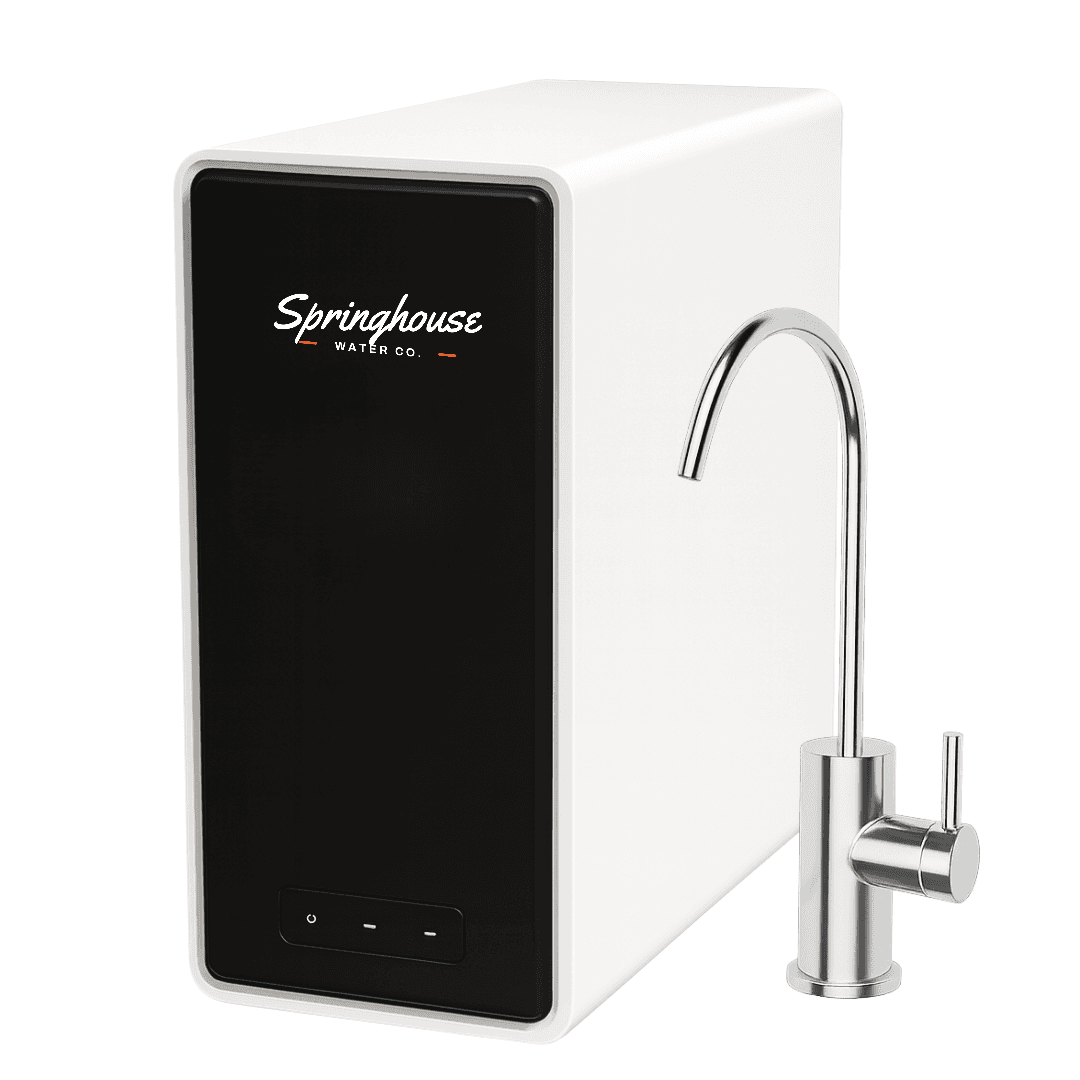
Everything the Whole Home system does at the main line, plus a seven-stage tankless reverse osmosis unit under the kitchen sink for the water you actually drink and cook with. Two different jobs, treated in the two places that make sense.
Chattanooga's published hardness is 4.4 grains per gallon (Tennessee American Water, Citico plant, 54-90 mg/L as CaCO3). That is moderately hard - not the 15 or 20 grains you would find in parts of the country, but well above the level where scale starts costing you a water heater.
This is the one most households end up on. The whole-home stage deals with the scale and the chlorine; the RO deals with what is still dissolved in the water once the carbon has done its work.
Component breakdown
The two halves, and what each is for
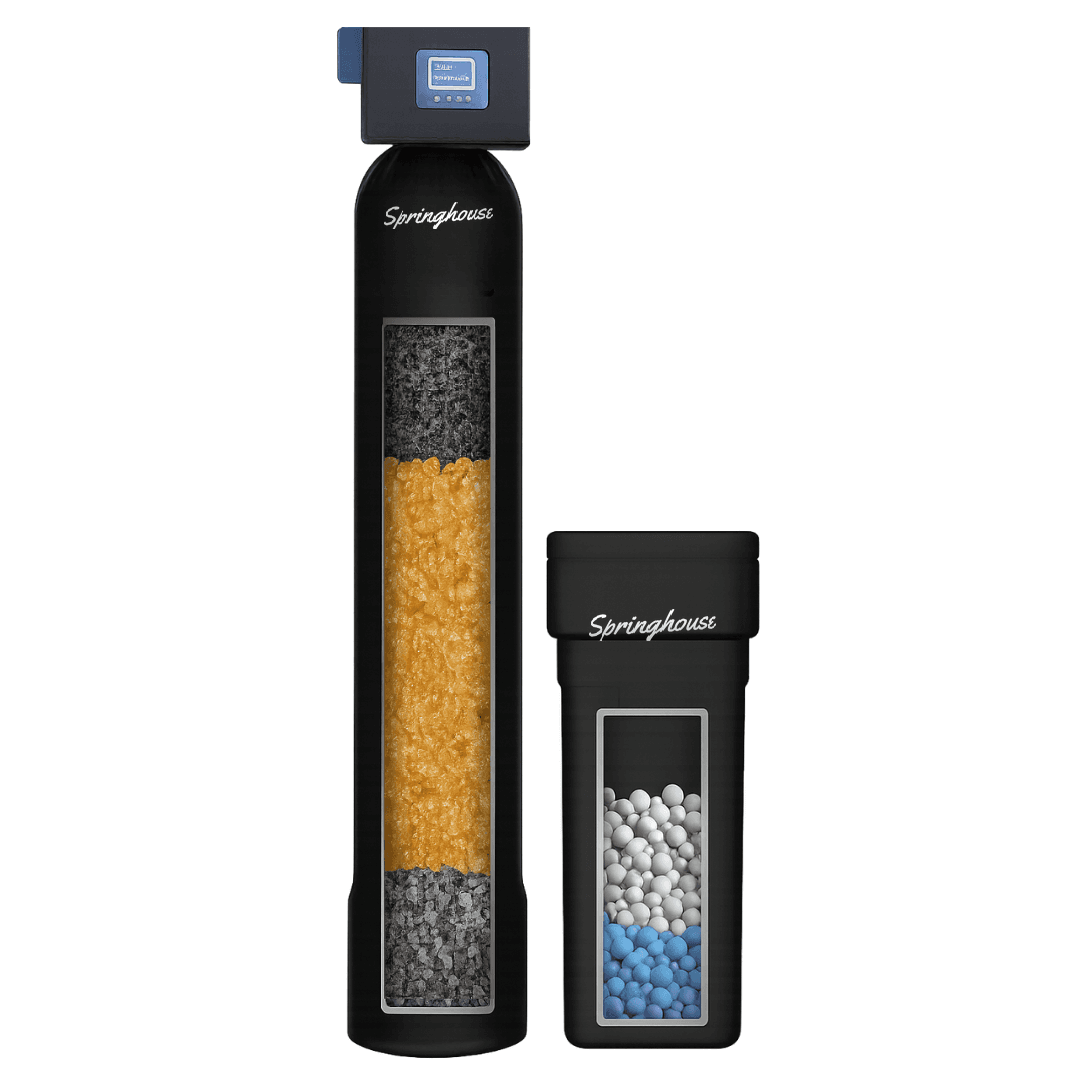
Softening is an ion exchange. Water passes through a bed of resin beads carrying sodium ions; calcium and magnesium - the two minerals that make water hard - swap places with that sodium and stay behind on the resin. Nothing is filtered out in the mechanical sense. The hardness is traded away. When the bed runs out of sodium to trade, the system rinses itself with brine, flushes the calcium to drain and starts again. That rinse is the regeneration cycle.
Carbon works the other way round. It does not trade anything - it adsorbs. Chlorine and the compounds that carry taste and smell stick to the enormous internal surface area of activated carbon as water passes through. One gram of it has the surface area of a tennis court, folded into pores. It is why carbon changes how water tastes while a softener does not.
Reverse osmosis is a third mechanism again. Household pressure pushes water against a semi-permeable membrane with pores small enough that water molecules pass and most dissolved content does not. What does not pass goes to drain. It is the only one of the three that physically separates dissolved solids out of the water.
The mixed bed
48,000 grains, softening resin and carbon in one tank at the main line.
The HW800 tankless RO
Seven stages, under the sink, with no storage tank taking up the cabinet.
Why tankless matters
A conventional RO stores treated water in a bladder tank that sits in the cupboard and holds water between uses. A tankless unit makes water on demand instead, which frees the cabinet and means you are drinking water produced when you asked for it.
The dedicated faucet
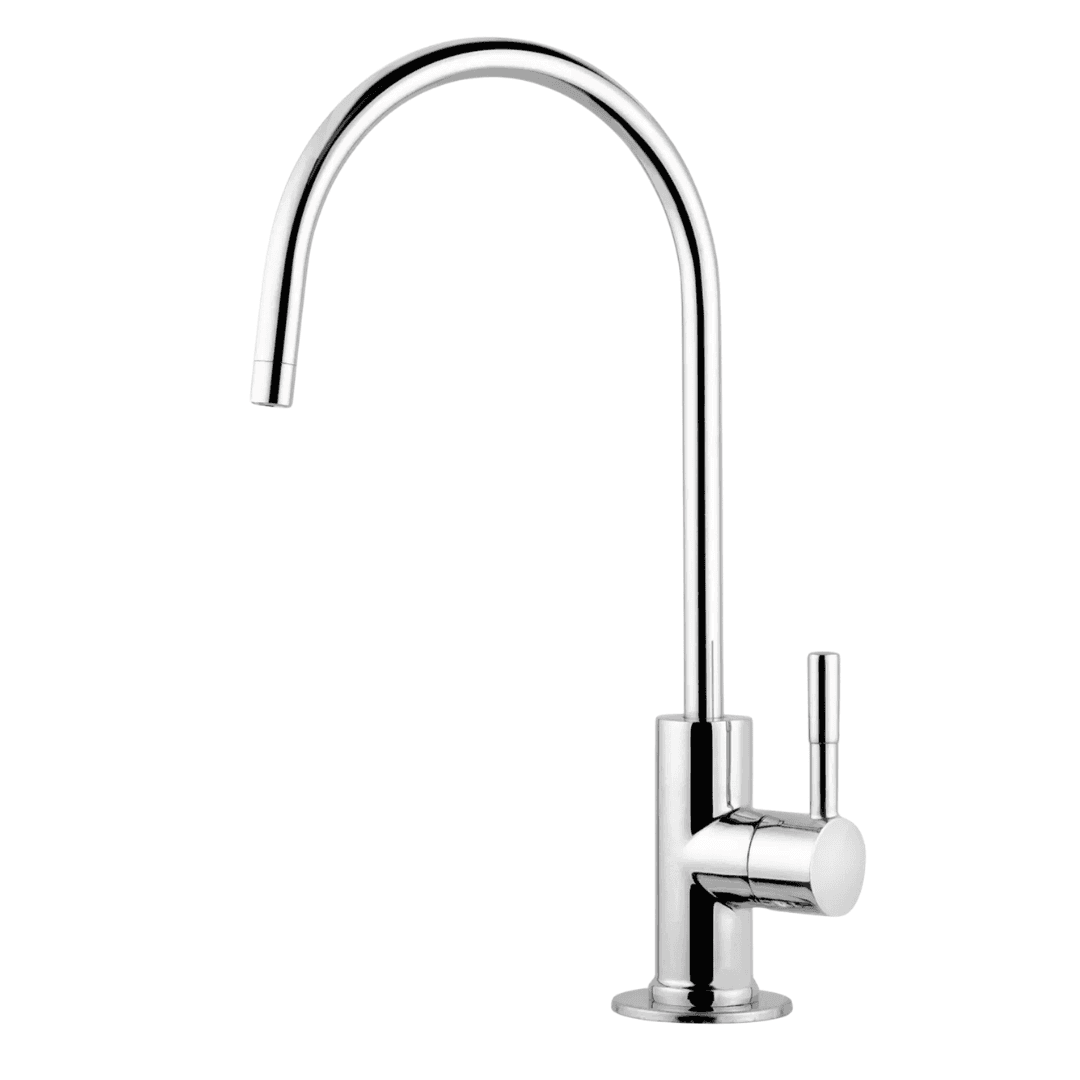
RO water runs to its own tap at the sink rather than through the mixer, because the two are treated to different standards.
Performance specifications
Capacity on the house side, output on the drinking side
The arithmetic is simple and worth doing before you buy anything. At 4.4 grains per gallon and roughly 60 gallons per person per day, a four-person household puts about 1,056 grains through the system daily, or about 31,700 a month. A 48,000-grain unit therefore regenerates roughly every six and a half weeks on that load. A smaller household goes longer between cycles; a bigger one goes shorter. That interval is what drives your salt use, not the size of the tank.
We publish the numbers our equipment supplier publishes and nothing beyond them. Where you see a flow rate or a rejection figure quoted to two decimal places on a water company's website, ask which test standard produced it. If the answer is not NSF/ANSI, it is marketing.
- Whole-home capacity
- 48,000 grains.
- Typical regeneration on Chattanooga water
- About every six and a half weeks for a four-person home, calculated from the published 4.4 gpg.
- RO stages
- Seven.
- Daily RO output and membrane rejection
- Both are manufacturer figures that depend on your incoming pressure and temperature. We give you the spec sheet with your quote rather than printing a number here that may not match your house.
Drinking water
What the RO stage changes
Carbon alone cannot reduce what stays dissolved in water. Reverse osmosis can, because it is a physical barrier rather than an adsorbent. That is the difference between water that tastes better and water that measures differently.
The change people report first is in coffee, tea and ice - the three things where water is most of what you are tasting. Cooking is the second: pasta water, stock and anything reduced down concentrates whatever was in the water to begin with.
A household buying bottled water by the case usually finds this is the part of the system that pays for itself, and it stops the plastic.
Before you buy
Worth understanding before you buy anything
RO produces some wastewater. Pushing water through a membrane means a proportion goes to drain carrying what was rejected. Modern units are far better at this ratio than older ones, and anybody who tells you there is no drain water is describing a different technology.
RO membranes and pre-filters are consumables on a schedule, not forever parts. Ask what they cost and how often before you buy, from us or anyone else. A cheap system with expensive annual filters is not cheap.
Softening and RO are complements, not alternatives. Feeding an RO membrane softened water is one of the better things you can do for its lifespan, because hardness is what scales a membrane.
What you get
Features
- HW800 tankless RO, no tank under the sink
- Takes PFAS and byproducts out of drinking water
- Written warranty terms with your quote
More photos
A closer look
Also in whole home systems
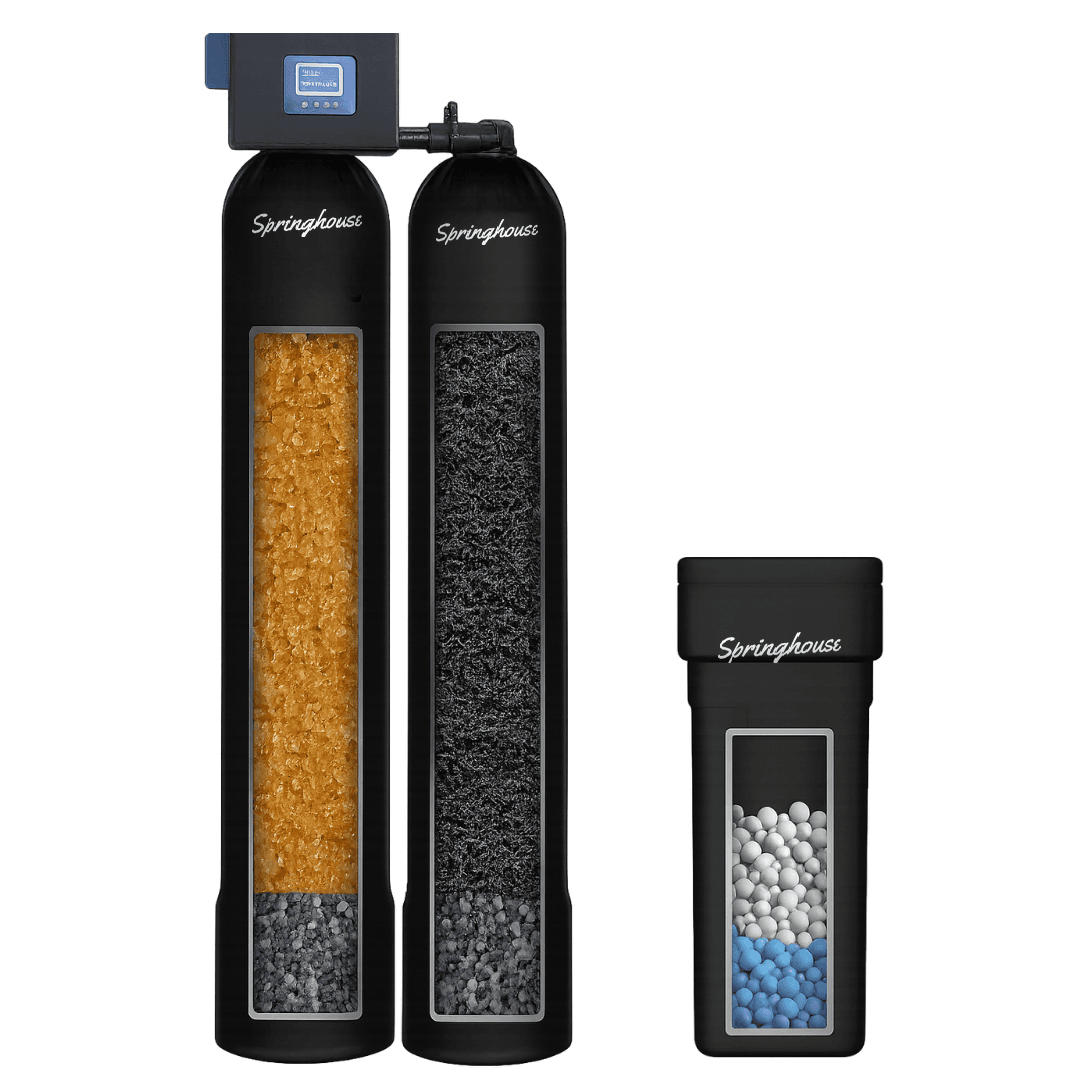
Dual Tank + Tankless RO
Separate catalytic carbon and softening tanks for bigger homes.
View details →Free water test
Find out what's actually in your water
We'll test your water at your kitchen sink, show you the result, and tell you what — if anything — you need. Free, and there's no system that fits every house.
- Free on-site water test
- Licensed plumber install
- Every price published